Why Does Matthew McConaughey Want a Personal AI?
Matthew McConaughey was on Joe Rogan recently and he had a lot of thoughts on how he wants to use AI.
He said he has "a little pride about not wanting to use an open-ended AI to share my information so it can be part of the worldwide AI vernacular."
Then he described exactly what he does want:
"I am interested in a private LLM where I can upload, hey, here's three books I've written. Here's my other favorite books. Here's my favorite articles I've been cutting and pasting over 10 years. And log all that in. And here's all my journals... so I can ask it questions based on that. And basically learn more about myself."
Here is the part on YouTube where he's saying this.
This is a Hollywood actor describing the future of personal computing more clearly than most technologists.
I've been thinking about this a lot lately. There are a few aspects to it.
First, data ownership. McConaughey wants his stuff to stay his. He understands that if you spend years loading an AI with your journals, your notes, your life context, you should be able to take that with you. You shouldn't be locked into one company's system forever just because that's where your data lives.
Second, personal context. He wants to upload his own books, his own journals, his own clippings from the last decade. He doesn't want AI that knows everything about the internet. He wants AI that knows everything about him.
Third, self-discovery. He said he wants to "ask it questions and basically learn more about myself." He even mentioned loading it with "aspirational" content. The man he's working to become. Then asking the AI questions based on that version of himself.
Doesn't ChatGPT Already Do This?
Joe Rogan pushed back. He said ChatGPT already develops a relationship with you. It gets to understand what you're interested in through conversations.
McConaughey's response was precise:
"No, I want the answers based on what I've uploaded it with only, not from the outside world."
He doesn't want an AI that slowly learns about him through conversations. He wants to load it with his data and get answers based on that.
This is a subtle but massive distinction.
ChatGPT has memory now. You can upload documents. It learns over time. So why isn't that enough?
You don't own that data. Everything you upload lives on OpenAI's servers. Your journals. Your notes. Your private thoughts. All sitting in their infrastructure, governed by their terms of service, subject to change whenever they decide.
You can't take it with you. Spend two years training ChatGPT to understand you. Thousands of conversations. Hundreds of documents. Then Claude releases something better. Or a new model comes out. You're starting from zero. All that context locked inside OpenAI's system.
You can't actually use it. This is the big one. ChatGPT's memory is a black box. You can't query it. You can't export it in a structured way. You can't ask "show me everything I've told you about my health goals" and get a clean table back. It's stored in abstract blobs you can't access directly.
McConaughey instinctively understood this. He wants his data to be his. Loadable, queryable, portable.
Joe Rogan mentioned that Gary Nolan at Stanford has something like this for cancer research. A private system where all their data is secure, but they can access AI through a portal. Their own library.
That exists for cancer researchers at Stanford. It doesn't exist for regular people.
Right now if you want this, you have to be technical. You have to spin up your own servers, manage your own databases, figure out embeddings and vector search. Most people can't do that. And they shouldn't have to.
The infrastructure for personal AI doesn't exist at the consumer level yet.
Here's what I think is about to happen.
Apps are going to die. I wrote more about this thesis in Apps No More.
Not all at once. But the concept of downloading separate apps for tracking meals, workouts, todos, journals, expenses, habits, check-ins... that's going away.
Instead, you'll have a personal AI that can do all of it. You'll say "track my workouts" and it will. You'll say "remember that I love Thai food" and it will. You'll say "what restaurants did I like in Italy?" and it will search through your own memories to find the answer.
The AI handles the reasoning. Something else handles the storage.
That's what I've been building.
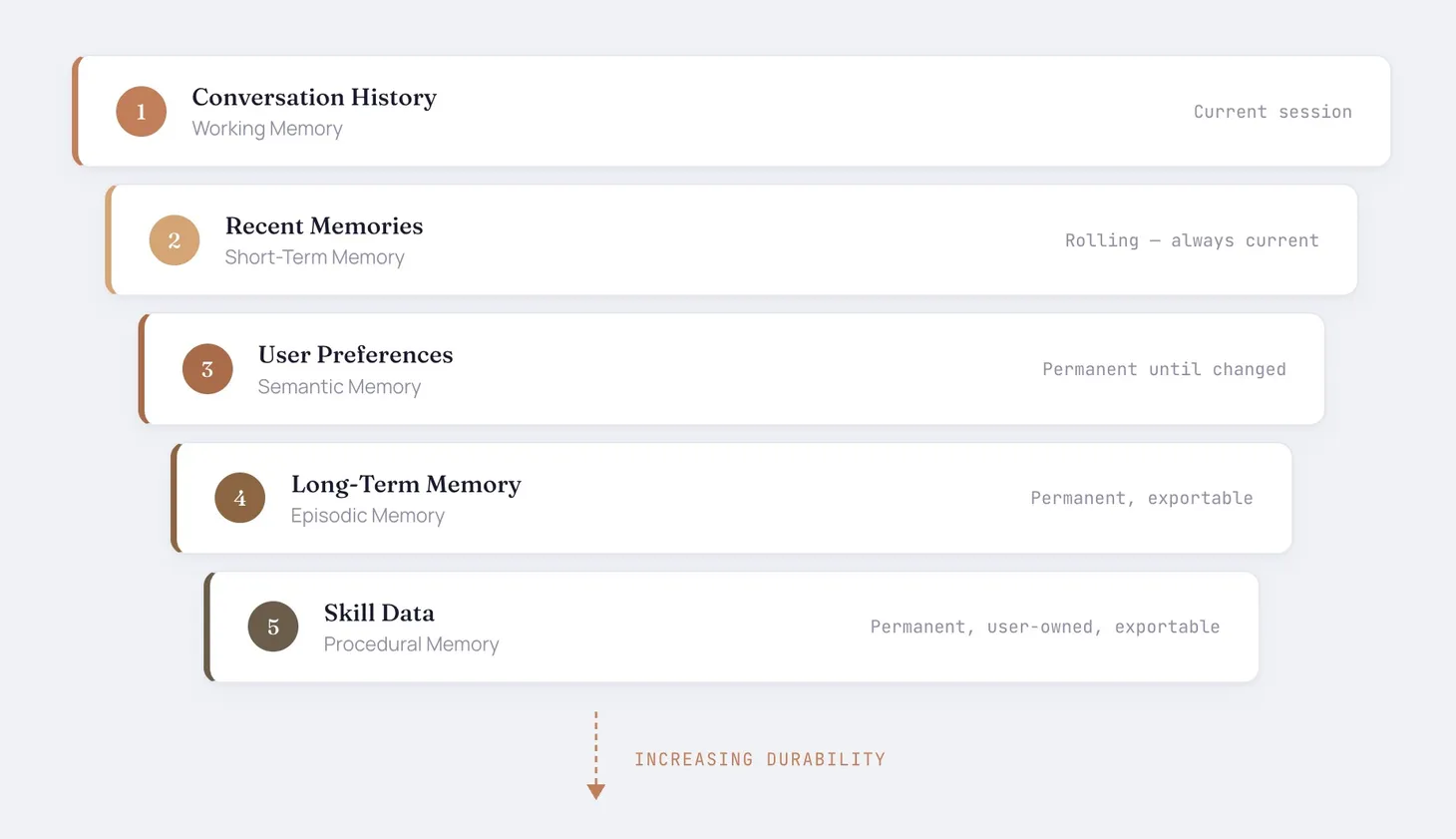
Arca is a data layer for personal AI. It gives you a private vault where your AI can store structured data (like meal logs and workout stats) and semantic memories (like journal entries and preferences). All of it exportable. All of it yours. Any personal AI builder can plug into it through API or MCP.
But most people don't want to build their own AI. They just want one that works.
That's Mio. It's a platform where you name your personal AI, teach it skills through conversation, and talk to it anywhere - email, chat, SMS, WhatsApp, voice. Under the hood, Mio uses Arca as its data vault. So your AI's memory is always yours.
Arca is the infrastructure. Mio is the product people actually use.
When McConaughey described uploading his journals and asking questions based on that, he was describing exactly what this enables.
What's interesting is that McConaughey isn't a technologist. He's just a guy thinking about how he wants to interact with AI.
What he described is a completely new way of thinking about our relationship with how we use AI.
Instead of giving all our data to cloud companies who store it in "abstract blobs that we can't get out", we keep it ourselves. Instead of using a dozen apps that each have a piece of our lives, we have one AI that knows all of it.
Our data lives with us. Portable, private, and not locked in some company's data jail.
When mainstream culture starts asking for this, the market will follow.
Matthew McConaughey just told us what he wants. I think a lot of people want the same thing.
I'm now on a mission to help them build it. I just started a YouTube channel called Build My AI and a newsletter at myai.build where I will walk through how to give a personal AI new skills, one at a time. Meal tracking. Workout logging. Todos. Journal entries. Personal CRM.
With every episode we'll replace dozens of app categories with personal AI skills.
Excited about this future.
DM me on LinkedIn if you'd like to jam on all this.
Bora
Maker's Wave Newsletter
Join the newsletter to receive the latest updates in your inbox.